Choosing between Invisalign and metal braces is one of the biggest decisions your family will make about your child’s smile. At Sycamore Orthodontics & Pediatric Dentistry, both options straighten teeth beautifully, but they work in different ways and suit different lifestyles. Here’s what you need to know to feel confident about the path you choose.

What Are Invisalign and Metal Braces?
Invisalign and metal braces are two proven orthodontic treatments that correct crowding, spacing, bite problems, and alignment issues. Invisalign uses a series of removable, clear plastic trays worn 20 to 22 hours a day. Metal braces use small brackets and archwires bonded directly to the teeth. Both are FDA-cleared and lead to the same goal: a healthy, straight smile.
At Sycamore Orthodontics & Pediatric Dentistry, we offer both treatments, which means your family isn’t limited to one option based on what we happen to provide. Instead, Dr. Peter Barysenka and our team tailor your cleanings and treatments around what fits your child’s teeth, age, and daily life. That flexibility matters when you’re weighing long-term results against day-to-day comfort.
Think of Invisalign and metal braces as two different roads leading to the same destination. One is nearly invisible and comes out for meals. The other stays put and does the work around the clock. Both are proven, trusted treatments, and either one can help your child smile bright for many years to come.
How Each Treatment Works
The mechanics behind each option are different, but the goal is the same: gentle, steady tooth movement over time.
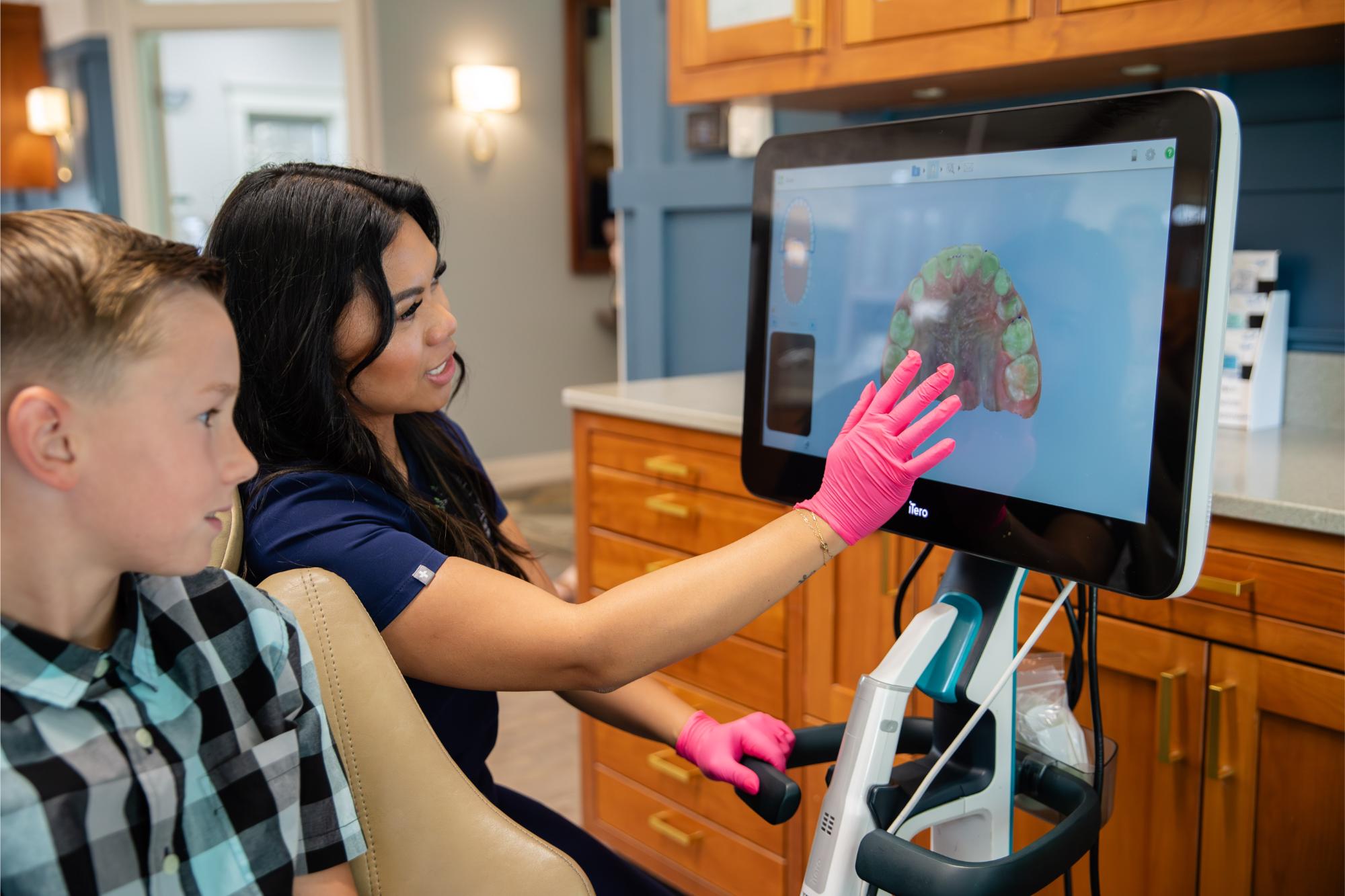
Invisalign starts with a digital 3D scan of your child’s teeth. No goopy impressions. From that scan, a custom series of aligner trays is made. Your child wears each tray for one to two weeks before swapping to the next in the series. Each tray shifts the teeth a little closer to their final position.
Metal braces begin with brackets bonded to each tooth and a thin archwire threaded through them. Every 4 to 8 weeks, your child comes in, so our doctors can adjust the wire and keep the teeth moving in the right direction.
Most patients complete treatment in 12 to 24 months, though the exact timeline depends on the case. Simple spacing might wrap up faster. Complex bite corrections can take longer.
One key difference: Invisalign only works when the trays are in the mouth. If your teen forgets to wear them, progress stalls. Metal braces are working 24/7 whether your child thinks about them or not.
Both treatments finish the same way, with retainers. Retainers keep the teeth in their new positions, so all that hard work sticks. Digital scanning is used for both workflows at our practice, which makes the process smoother and more accurate from start to finish.
Benefits of Invisalign vs. Metal Braces
Each option has real advantages. The right choice depends on your child’s age, personality, and daily activities.
What are the advantages of Invisalign?
- Nearly invisible in photos and everyday interactions
- Removable for meals, so no food restrictions
- Easier to brush and floss since the trays come out
- Fewer emergency visits (no broken brackets or poking wires)
- More comfortable for many patients
- Great for senior photos, prom, and big life moments
What are the advantages of metal braces?
- Handle complex cases that aligners can’t always tackle
- No compliance worries since they’re always on
- Well-suited for younger kids still developing habits
- Ideal for contact-sport athletes when paired with a mouthguard
- Fun for kids who love picking colorful bands
Both options improve long-term oral health, bite function, and confidence. That’s the real win, no matter which path you choose.
Family lifestyle matters, too. If your teen plays trumpet in the marching band at school, Invisalign might feel easier. If your child is wrestling or playing football, some parents prefer the durability of braces with a proper mouthguard. If your daughter is heading into her senior year and wants a clear smile for graduation photos, Invisalign is often a great fit. Kids in theater programs sometimes love the freedom to take trays out before big performances.
There’s no single “best” answer. There’s only the best answer for your family.
Side-by-Side Comparison
Here’s a quick look at how the two options stack up.
| Feature | Invisalign | Metal Braces |
|---|---|---|
| Appearance | Nearly invisible | Visible brackets and wires |
| Comfort | Smooth plastic, no wires | Some initial soreness, wire pokes possible |
| Treatment duration | 12-24 months | 12-24 months |
| Office visits | Every 6-8 weeks | Every 4-8 weeks |
| Emergency risk | Very low | Occasional broken brackets |
| Diet restrictions | None (trays come out) | Avoid sticky, hard foods |
| Hygiene | Easy (remove to brush) | Requires extra care around brackets |
| Compliance needed | High (must wear 20-22 hrs) | Low (always on) |
| Best for mild cases | Excellent | Excellent |
| Best for complex cases | Good, case-dependent | Excellent |
| Kids under 12 | Limited options | Often preferred |
| Teens | Great with Invisalign Teen | Great option |
| Adults | Very popular choice | Effective, less discreet |
Use this side-by-side view as a starting point, not a final answer. Every mouth is different, and a consultation can walk you through what applies to your child specifically.
Who Is a Good Candidate?
Age and case complexity both play a role in the right choice. Here’s a general breakdown by age group.
Young children (ages 7-11):
- Metal braces or early interceptive appliances are usually the best fit
- Kids this age may not have the discipline for full-time aligner wear
- Early treatment can guide jaw growth and make later care simpler
Teens (ages 12-17):
- Both options work well
- Invisalign Teen is designed for this age group and suits motivated, responsible patients
- Metal braces are a reliable pick when compliance is uncertain
Adults:
- Invisalign is very popular for its discretion in professional settings
- Metal braces remain the go-to for complex bite corrections
- It’s never too late to straighten your smile
Contact-sport athletes:
- Many prefer Invisalign because trays come out for mouthguards
- Braces work fine with a properly fitted sports mouthguard
Complex cases:
- Severe crowding, significant rotations, or major bite issues often need braces
- Some complex cases can still be treated with Invisalign, but it depends
A consultation with our doctors is the only way to know for sure what fits your family best. They evaluate each child individually and recommend the option that will deliver the best result. That personal evaluation matters far more than any online comparison chart, because every mouth, bite, and growth pattern is unique.

Frequently Asked Questions
Which treatment works faster?
Both Invisalign and metal braces typically take 12 to 24 months to complete, depending on the case. Speed depends more on how much movement your teeth need than on which system you pick. Invisalign can be slightly faster for mild cases when patients wear trays consistently, while braces often win for complex corrections.
Can my teen be trusted with Invisalign?
That depends on your teen. Invisalign requires wearing the trays 20 to 22 hours a day, which means only removing them for meals and brushing. If your teen is organized, motivated, and responsible with their belongings, they’ll likely do great. If forgetting things is part of daily life, metal braces might be a safer bet.
Do metal braces hurt more than aligners?
Both can cause mild soreness, especially in the first few days after adjustments or when starting a new aligner tray. Invisalign tends to feel gentler because the plastic is smooth and there are no wires or brackets to irritate cheeks. Any discomfort with either option usually fades within a day or two.
Does insurance cover both options?
Most dental insurance plans with orthodontic benefits cover a portion of both metal braces and Invisalign at the same rate. Coverage varies by plan, so check your policy details or ask our front desk to review your benefits with you. HSA and FSA funds also apply to either treatment.
What if my child plays football or wrestles?
Both treatments can work for contact-sport athletes. Invisalign is often preferred because the trays come out during games, allowing your child to wear a standard mouthguard. Metal braces work too, but they require a specialized orthodontic mouthguard to protect the lips and cheeks from the brackets.
How do I know which option is truly right for my child?
The best way to decide is a face-to-face consultation with our doctors, who can examine your child’s teeth, bite, and growth patterns. Your family is special, and the right choice will consider your child’s age, personality, activities, and long-term oral health goals. Both Invisalign and metal braces can help your child smile bright for many years to come, so the real question is which path feels most comfortable for your daily life.